
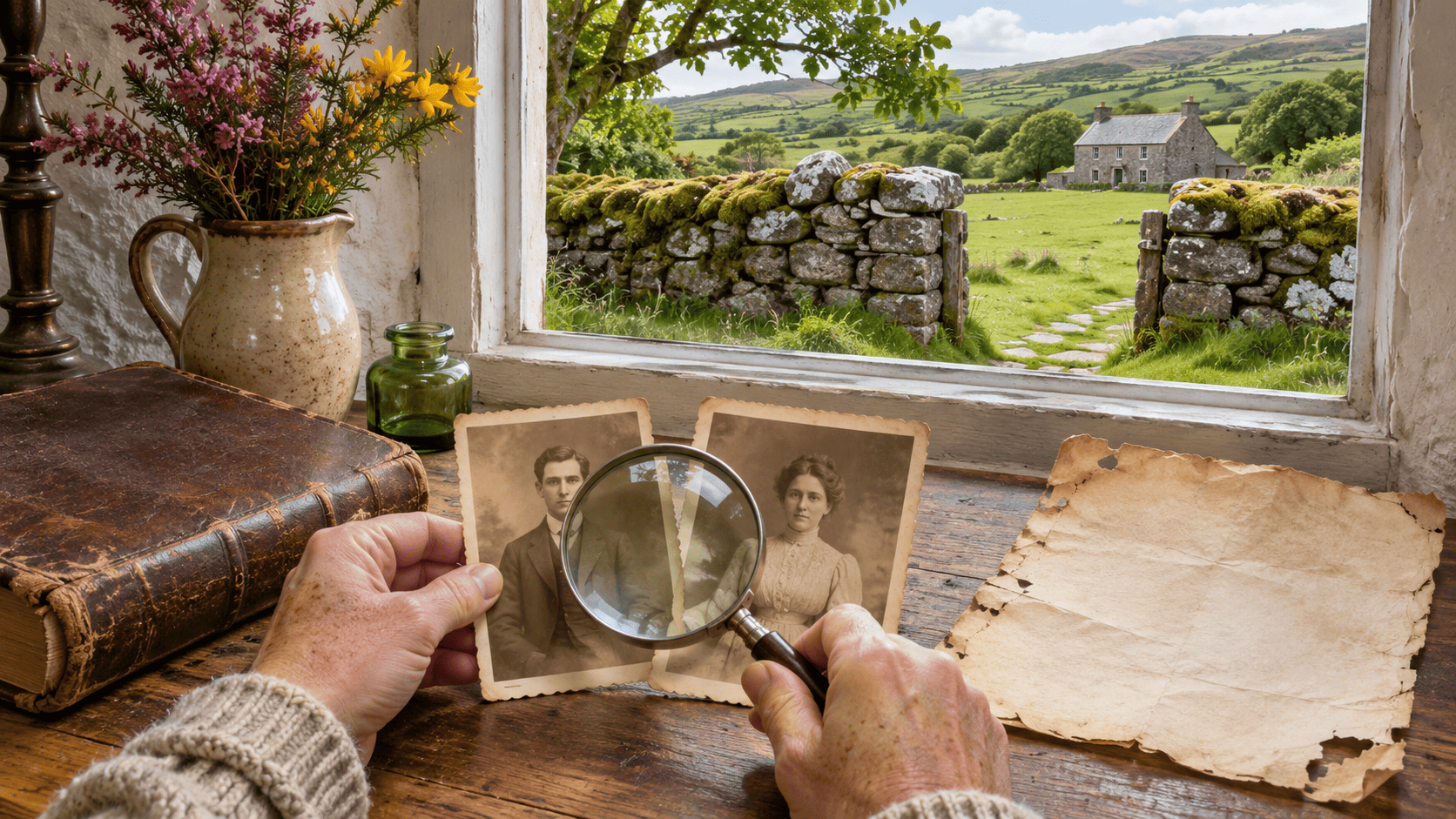
Tracing Irish ancestors often stalls after only a few generations. Many researchers reach a point where the trail goes cold and the next record seems to have vanished. I have spent years working through Irish family histories, and the same problems keep coming up. Records go missing for a small set of predictable reasons. The same practical steps tend to get past most of them, and I explain how to work around them.
A gap in one archive rarely ends the search. Irish genealogy uses several record types that can point toward an ancestor even when a direct record is lost. I have found that knowing how those sources connect to each other makes the biggest difference. We try to keep that connection in view from the very first search, and it saves time later.
Why Irish Genealogy Research Is Often Harder Than Expected
Most families begin with a story passed down over the years. The story usually names a county or a village, and that gives a useful place to begin. In my work, the details tend to blur once the search moves back past the late 1800s. That is where Irish genealogy research becomes slower and more demanding than many beginners expect.
If you want a structured overview of how irish genealogy researchers work through these problems, the LinkedIn article linked here can be a helpful starting point. The page describes the general process in plain terms, which may suit someone just starting out. Reading it before the first search can help set realistic expectations and a sensible plan.
Most of the difficulty comes from how Irish records were kept and what survived over time. Wars, fires, floods and simple neglect all removed material from the archives. Clerks also recorded names in different ways from one parish to the next. Knowing these causes makes the gaps easier to handle. It also keeps frustration from turning into wasted effort, which is something I have seen many times.
Understanding the Losses in Irish Record Keeping
Many researchers do not realize how much Irish material was lost. A loss that surprises most people came in 1922, when fire destroyed the Public Record Office in Dublin. The fire took much of the nineteenth century census material along with many early wills and legal documents. Knowing this early saves a lot of wasted searching in the wrong places.
The fire explains why so many searches end early. When I search for a family that disappears before 1901, I first check the neighboring years. Some census fragments survived, and substitute sources from other materials can fill part of the gap. The 1901 and 1911 censuses survived in full and are widely available online, so they make a good anchor for any search.
Gaps in Civil Registration Before 1864
Civil registration of births, marriages and deaths in Ireland began in 1864 for most people. Non-Catholic marriages were recorded from 1845, but many everyday families have no civil record for their early lives. Church registers were the main official source before that. Because of this timing, a missing civil certificate is normal. Many families still appear in parish books even when no civil entry exists.
Using Church and Parish Records Effectively
Church registers can fill many of the gaps left by civil records. Coverage varies widely between parishes and denominations, and some registers begin in the 1700s while others start much later. Before searching, I check which parish held the family and which years survive. That quick check tells me whether the search is worth the time.
Indexes can help locate a baptism or marriage quickly, but I still read the original entry because the index is only a finding aid. Records often list parents, witnesses and godparents. These names can reveal family connections that the ancestor’s own record does not show. Witnesses are often siblings, cousins or close neighbors, so I write down every name, even unfamiliar ones.
Spelling is another common obstacle. Clerks wrote names as they heard them, so the same surname may appear in several forms across a few years. When a search returns nothing, I try variations of the surname and given names. A small change in spelling often turns up an entry that seemed impossible to find. Keep a list of the spellings you have tried so you do not repeat them, and note which parish registers you have already searched.
Finding Ancestors in Land and Tax Records
Land and tax records give a useful picture of where families lived. Griffith’s Valuation, carried out between about 1847 and 1864, lists householders and land occupiers by townland. Once you have a townland name, the search becomes much narrower. Tithe applotment books from the 1820s and 1830s recorded landholders in many parishes. I usually check them after the church registers, once I know the parish.
These records are not complete, but they can name a head of household who may be an ancestor. Wills and administration records sometimes name relatives, and I use those names to look for siblings or in-laws. Each new name gives another route into the search. So I rarely stop at one record type.
Matching Townlands to Parish Records
A townland is a small land unit, and it often sits within a known parish boundary. Use the townland name to connect land records with church registers. Without that link, two people with the same name are easy to confuse. I always write the townland beside each record I find. Over time, this habit builds a clear map of where each family lived.
Step-by-Step Methods for Breaking Through Brick Walls
When a search stalls, a clear method helps more than guessing at random. I use a short sequence of steps on hard cases, and I have found that the order matters as much as the steps themselves. The list below is a practical starting point that you can adjust to your own family. Each step builds on the one before it, so the work stays organized and easy to review later.
- Write down the exact question you want the next record to answer.
- List every record type that could hold that answer for the time and place.
- Search for the family in neighboring parishes and townlands.
- Test alternate spellings of surnames and given names.
- Record every result, including negative searches.
Negative searches matter more than many beginners think. A failed baptism search in one parish tells you where not to look again, and that alone can save a whole afternoon. Over time these notes become a map of the areas you have already covered. Revisiting old questions is part of the method too. Some brick walls open after a new collection goes online, so I check back every few months and keep a short list of open questions for that reason.
Using Emigration and Passenger Records to Close Gaps
Many Irish families left the country, and emigration records can help close the gap. Passenger lists for ships leaving Irish and British ports often name the traveler and the last place of residence. These details may point back to a specific county or parish. A single entry can turn a vague family story into a specific place.
Records from the destination country matter just as much. Census returns, naturalization papers and church records in North America, Britain or Australia sometimes state the place of birth in Ireland. A county name is useful, and a parish name is a welcome bonus. Start with the county, then look for the parish once you have it.
Family stories about emigration should be checked against documents before you accept them. Memory shifts over generations, so a story about a port or year may be off. Let the records set the timeline and keep the story as a clue until a document confirms it. A departure year and a county of origin can separate one traveler from another. I keep the source for each detail so I can check it later.
Organizing Findings and Recording Conflicting Evidence
Good organization prevents wasted effort. Keep a file for each person with the record, the date, the source and the reason it was chosen. Use consistent names for places and people. In my experience, this habit makes conflicting evidence easier to spot. Citations also help other researchers and your future self. I keep a short note about where each record was found, and I save copies or screenshots. Online collections change over time, so links can break without warning. A short note now costs only a minute.
Handling Records That Disagree
When two records disagree, record both. Do not discard the one that fits less neatly with your existing tree. Conflicts often reveal a second family with the same surname or a simple clerical error. Noting the difference now saves confusion later. I write the difference down in plain words.
I keep conflicting entries in the same file, with a short note explaining the gap. That way the question stays open until another record settles it. Closing a question too early is one of the easiest ways to build a wrong tree.
Overcoming Missing Records and Ancestral Brick Walls in Irish Genealogy Research
Missing records are a normal part of Irish genealogy research. A gap usually points to a different route, so most families can still be found. The 1922 fire and the late start of civil registration both create gaps, and inconsistent spelling adds another layer of difficulty. Keep the sources you already checked in view, so each new search builds on the last. Land records, church registers, emigration lists and neighboring families can fill in the picture when the direct record is gone. Patience matters as much as any single source, since each one you check adds another piece to the story.
A clear method helps most of all. I write down the question, list the sources that could answer it and log every result, including the failed searches. Over time those small notes add up to a reliable family history. Those notes also tell you which searches not to repeat, which saves time on the next question. Start this week with one brick wall. Choose a single ancestor, write the exact question you need answered and list three records that might hold the answer. Then run the first search and log the outcome, even when it finds nothing.